From Anxiety to Calm: A Child Life Specialist's Experience with VR in Procedural Care
Organisation:
A leading children's hospital in the Midwest
Location:
Midwest, United States
Department:
Ambulatory Care, Burns
Customer
A leading children’s hospital in the Midwest, consistently voted among America’s Best Children’s Hospitals, is widely recognised for its commitment to innovation and excellence in paediatric care. Known for pioneering new approaches to improving clinical outcomes and patient experience, the hospital integrates evidence-based technologies into everyday practice.
This hospital has implemented Smileyscope through many departments, including a busy ambulatory clinic spanning primary care, labs and burns.
Challenge
Before introducing Smileyscope, the clinic relied on traditional distraction tools such as iPads, large ISPI books and sensory toys. While helpful, these options often fell short for more painful or repeated procedures, particularly burns dressing changes and wound graft care. Children could still see needles or bandages, anxiety remained high, and staff were required to invest constant effort into keeping patients engaged.
The care team noted that many patients would benefit most from not seeing the procedure at all and being fully immersed in distraction. While VR had the potential to solve this, existing systems such as Starlight were cumbersome. They took time to set up, were difficult to fit, and relied on controllers at moments when patients’ hands were injured or needed to be accessed for the procedure itself. As a result, VR was technically available but rarely practical to use, leaving the clinic to continue managing inefficiencies, heightened anxiety and longer procedures.
“There are a lot of patients who would benefit from not being able to see, and being fully immersed in distraction… The VR has completely changed the game.” – Lenore Fleming, Certified Child Specialist
Solution
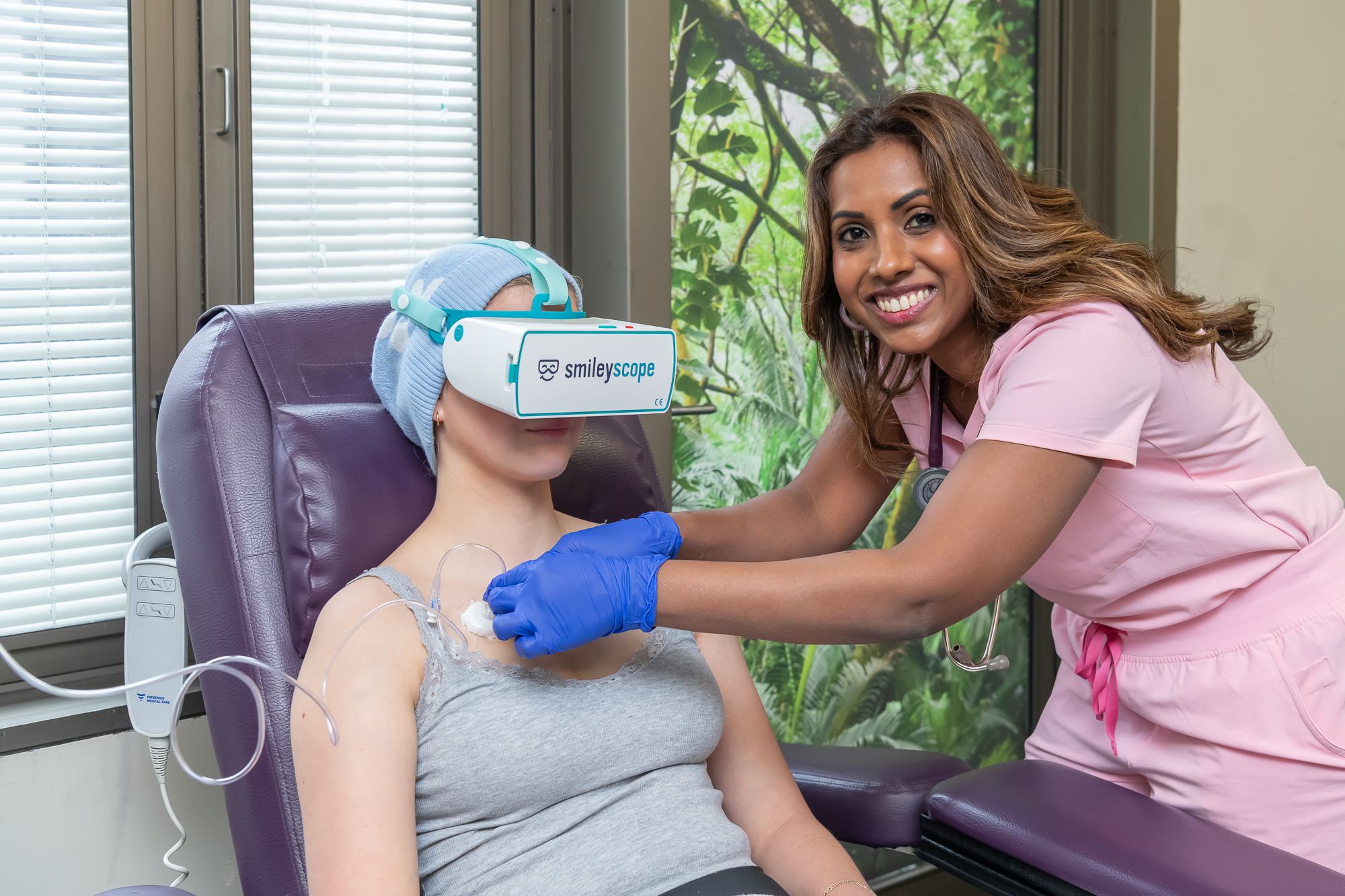
Smileyscope was introduced as an additional tool in the Child Life toolbox, complementing existing pain management and distraction strategies rather than replacing them. What immediately set it apart was its simplicity. The headset could be applied in seconds, often without the need for headstraps, and required no controllers. From the clinician’s perspective, this ease of use removed the primary barriers that had prevented earlier VR solutions from being widely adopted.
The system’s versatility also played a key role. Children were drawn to the technology because VR is inherently appealing, and being offered it as a choice increased engagement. Relax and Games modes are particularly popular because they offer multiple options and allow children to feel in control.
Because the clinician had prior experience with more complex VR systems, Smileyscope felt immediately intuitive. Time was invested in understanding the content library so that experiences could be matched to each child’s age, anxiety level and preferences, ensuring the technology was used thoughtfully rather than generically.
“Takes hardly any time – less than 15 seconds, and we’re ready to go… So much easier than other VR systems” – Lenore Fleming, Certified Child Specialist
Impact
In day-to-day practice, Smileyscope has delivered clear benefits for both patients and staff. The clinician reports that clinic flow has not been slowed in any way. Setup typically takes less than fifteen seconds, allowing procedures to begin quickly and smoothly. For children who choose to fully engage with the headset, the perceived duration of procedures is dramatically reduced. In the clinician’s words, when a child is immersed, “time is chopped in half.”
This impact is particularly evident during burns dressing changes. Bandage removal, including the soap phase that often causes stinging, is noticeably faster. Children may still wince, but they remain engaged, allowing staff to complete care more efficiently. Smileyscope is also used in sedated burns procedures, offering an additional layer of comfort and distraction.
The technology has also had a positive effect in gynaecology and IUD clinics, where anxiety can be high, especially among adolescents. Many patients in these settings choose to use VR, reporting that it helps them feel calmer and less nervous. In some cases, patients initially think they want VR during the procedure but decide against it partway through; Smileyscope is then reintroduced at the end to close out the appointment on a positive note. This flexibility has been one of the system’s strengths, reinforcing that it can be used in multiple ways rather than following a single rigid model.
From an efficiency standpoint, the clinician is confident there are meaningful cost and time savings. Faster procedures mean more time available in burns clinics, and smoother experiences reduce the emotional and logistical load on staff. Typically, Smileyscope is offered to about half of eligible patients aged four and older, with roughly seventy-five percent accepting when given the option. Most clinics traditionally rely on pre-medications such as acetaminophen, ibuprofen and, in more severe cases, opioids; Smileyscope provides a powerful non-pharmacological layer that supports these approaches.
“Smileyscope isn’t used only “one way” - you can use it in multiple ways with different patients and procedures, and it supports both procedural and post-procedure calming.” – Lenore Fleming, Certified Child Specialist
Going Forward
While the clinician considers themselves one of Smileyscope’s strongest advocates, they see significant opportunities to expand into new areas which would further enhance patient experience across the organisation.
Education and culture change are central to the clinician’s ongoing approach. Whenever students are being trained, Smileyscope is introduced early and explored in depth. Students are encouraged to spend time learning the system and experimenting with different experiences, and the feedback has been consistently positive. The clinician emphasises that Smileyscope does not disrupt clinic flow; instead, it expands what is possible, allowing care teams to support children in more personalised and effective ways.
Looking ahead, Smileyscope is seen not as a novelty but as a durable part of the care model: one that can continue to support paediatric patients, adolescents and staff alike across burns, procedural care and women’s health clinics.
“It’s such a good tool, and it doesn’t get in the way of clinic flow – it just gives you more ways to help kids cope.” – Lenore Fleming, Certified Child Specialist
See why 10,000 other clinicians use Smileyscope
Join leading hospitals and clinics delivering superior patient outcomes with evidence-based VR technology. Book a demo to see how Smileyscope transforms procedures in your healthcare setting.